The objective of this article is to explain why construction companies are increasingly adopting drone surveying services and how this technology is improving project planning, efficiency, safety, and data accuracy. It explores the limitations of traditional surveying methods, the practical applications of drone-based surveys, cost considerations, and the role of advanced aerial data solutions in modern construction workflows.
Drone surveying services significantly reduce survey time compared to traditional ground methods.
Construction companies benefit from improved accuracy through LiDAR, GPS/GNSS, and photogrammetry technologies.
Drone surveys generate valuable outputs such as orthomosaic maps, DEMs, point clouds, and contour maps.
Drone building surveys simplify inspections of roofs, facades, and structures while reducing safety risks.
Drone topographic survey costs are often lower than traditional surveying when considering long-term project savings.
The construction industry is rapidly adopting technologies that improve project efficiency, accuracy, and safety. Among these innovations, drone surveying services have emerged as a practical solution for modern construction challenges. By providing faster data collection, precise mapping capabilities, and reduced operational risks, drones are transforming how construction companies manage projects from planning through completion. This article examines the key reasons behind the growing shift toward drone surveying services, including cost considerations, workflow improvements, safety advantages, and the role of aerial data in supporting smarter construction decisions.
The construction industry has always been about adapting to change. From the days of steam-powered machines to the modern era of GPS technology, each decade introduces innovations that transform the way we build. Right now, drone surveying services are at the forefront of this evolution, and the pace of change is quicker than many anticipated.
At Drone Lidar Mapping, we collaborate closely with construction companies, project managers, and site engineers nationwide. One thing we consistently hear is that once a team experiences the benefits of aerial drone surveying on a project, they seldom revert to traditional methods. In this article, we’ll explore the reasons behind this shift, drawing on real-world experiences and the latest advancements in aerial data collection.
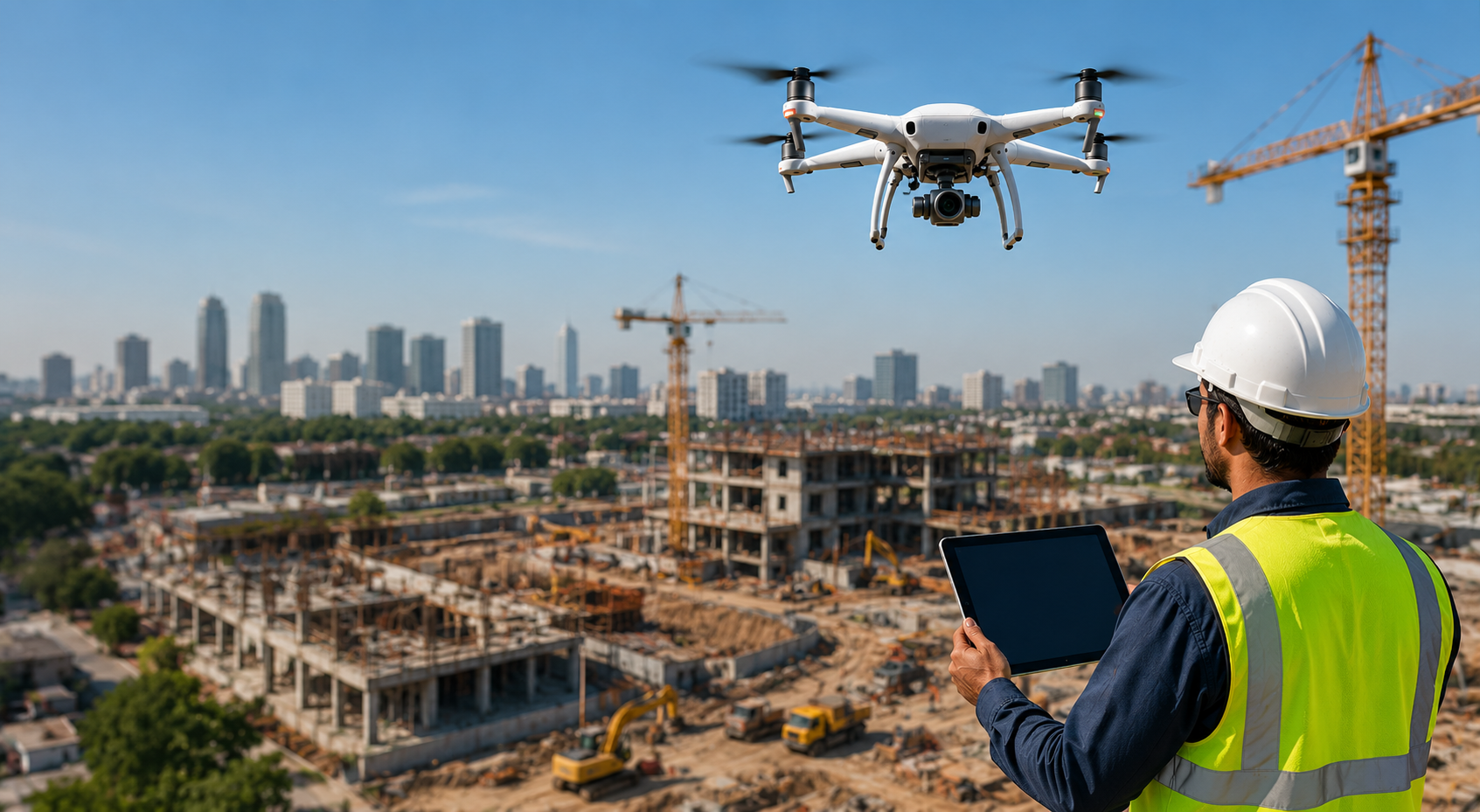
Traditional land surveying is all about getting boots on the ground — quite literally. A survey crew heads out to the site, sets up control points, takes measurements, and then heads back to the office to manually process all that data. When dealing with a large or complicated site, this whole process can stretch out over days or even weeks.
The challenges can pile up quickly:
For a construction company juggling tight budgets and even tighter deadlines, every delay can hit the bottom line hard. This is exactly where drone surveying services come into play — not as a flashy gimmick, but as a real game-changer for operations.
Modern drone surveying goes way beyond just “taking pictures from the air.” It’s a complex process that involves gathering and analyzing data through aerial imaging, GPS/GNSS positioning, LiDAR sensors, and photogrammetry software to create outputs that meet survey-grade standards. At Drone Lidar Mapping, our drone surveys usually provide:
Orthomosaic maps — these are georeferenced aerial images carefully stitched together to form accurate, scaled maps.
Digital Elevation Models (DEMs) — offering precise 3D representations of terrain.
Point clouds — dense LiDAR data that’s perfect for volumetric and structural analysis.
Contour maps — crucial for planning drainage and calculating cut/fill requirements.
These outputs aren’t just rough estimates; they are deliverables with centimeter-level accuracy, validated against ground control points. That kind of precision is exactly what construction project managers need to make informed decisions.
One of the most exciting developments in the industry right now is the rise of drone building surveys. In the past, checking out a building’s roof, facade, or structural components meant relying on scaffolding, rope access teams, or cherry pickers — all of which can be slow, expensive, and come with the risk of working at heights.
But with a drone building survey, everything changes. A skilled drone pilot can provide:
Construction companies are now turning to drone building surveys for everything from pre-purchase inspections to mid-construction quality checks and final handover assessments. The time savings are remarkable — what used to take two days of setting up scaffolding can now be done in just a two-hour drone flight.
For renovation and refurbishment contractors, having precise visual documentation of existing structures before starting work has become a real game-changer.
One of the most common questions we receive at Drone Lidar Mapping is about drone topographic survey cost. Many construction companies assume that cutting-edge aerial technology must come with a prohibitive price tag. The reality is quite different.
When you compare drone topographic survey cost against traditional methods, the savings are significant:
Survey Method | Time on Site | Processing Time | Typical Cost Range |
Traditional Ground Survey | 3–7 days | 2–4 days | £££ (High) |
Drone Topographic Survey | 4–8 hours | 1–2 days | ££ (Moderate) |
Beyond the direct cost, consider the downstream savings. Accurate topographic data at the start of a project reduces the likelihood of costly redesigns, unexpected earthworks, and disputes over quantities. A drone topographic survey that costs a few thousand pounds can prevent redesign bills that run to tens of thousands.
For smaller plots — up to 5 hectares — drone surveys offer particularly strong value, as the mobilisation costs of traditional survey crews are relatively high regardless of site size. Larger infrastructure projects also benefit enormously, given the speed at which drones can cover ground compared to survey teams on foot.
Drone land surveying isn’t just a one-off task — it brings value throughout every phase of a construction project:
Pre-Construction
Before any machinery hits the ground, drone land surveying gives a precise snapshot of the existing landscape. This information is crucial for site planning, drainage design, foundation engineering, and calculating volumes. Getting this right from the get-go helps avoid expensive fixes down the line.
During Construction
Using drone land surveying for progress monitoring lets project managers see how the current site conditions stack up against the design model in almost real-time. They can accurately calculate stockpile volumes and keep tabs on earthwork progress week by week. Any deviations from the plan are spotted early, preventing them from turning into costly issues.
Post-Construction
As-built surveys ensure that the finished work aligns with the design specifications. For infrastructure projects, this documentation is often required by contracts or regulations. Drone land surveying streamlines this process, making it quick and the results reliable.
This lifecycle approach is one of the reasons why drone land surveying has evolved from a specialized skill to a go-to tool for innovative construction companies.
When you look beyond the usual arguments about time and cost, there’s one factor that’s really speeding up adoption more than anything else: safety.
Construction sites are notoriously dangerous places to work. Surveyors often find themselves on steep slopes, near deep excavations, in tight spaces, or on shaky ground, facing real risks every day. But with drone surveying services, we can gather the necessary data without putting anyone in harm’s way.
At Drone Lidar Mapping, we frequently survey locations that would have once required surveyors to navigate through serious health and safety hazards — think cliff edges, contaminated areas, active flood zones, and unstable structures left after demolition. A drone can gather all the same information without a single person needing to step into those risky zones.
For construction companies that prioritize strong health and safety practices, this isn’t just a small perk — it’s a fundamental part of their operations.
Let’s get straight to the point: drone technology is now a well-established field. What really sets apart a top-notch drone surveying service from a mediocre one isn’t just the gear they use — it’s the expertise that drives it.
At Drone Lidar Mapping, our surveyors bring together formal geomatics qualifications and extensive hands-on experience in construction settings. We know the ins and outs of CAD integration, BIM workflows, coordinate systems, and the specific data formats your engineering team truly needs. We don’t just operate drones; we provide survey data that fits perfectly into your project workflow.
This level of expertise is why construction companies keep coming back to us, project after project. The drone is merely a tool; the real value lies in the knowledge we provide.
There are several key factors fueling the swift rise of drone surveying services in the construction industry:
Regulatory maturity — The frameworks for commercial drone operations in civil aviation are now well-established, which helps procurement teams feel more confident in their decisions.
Software advances — Processing platforms have become quicker and more user-friendly, leading to significantly faster turnaround times.
Client expectations — Developers and infrastructure owners are increasingly looking for drone-derived data as a standard part of their project deliverables.
Insurance and liability — Having accurate records before and after construction is becoming a common practice in risk management.
All these factors combined mean that drone surveying services have moved beyond being just a novel idea; they are now a standard capability that can be easily procured.
At Drone Lidar Mapping, we specialize in providing top-notch drone surveying services tailored for construction companies, whether you’re working on a cozy residential project or a massive civil infrastructure endeavor. Need a drone building survey, a drone topographic survey, or a comprehensive drone land surveying program across several sites? Our dedicated team is here to deliver precise, timely, and actionable data that you can rely on.
Thanks to our Skyelink technology, our drone operations enjoy robust, high-performance connectivity and data transmission. This means your survey data gets to you quickly and accurately, regardless of the size or location of your project.
Drone surveying services use unmanned aerial vehicles (UAVs) equipped with cameras, GPS, LiDAR, and photogrammetry technology to collect site data and create accurate maps, terrain models, and construction insights for planning and project management.
Modern drone surveying services can achieve centimeter-level accuracy when combined with ground control points (GCPs), GPS/GNSS technology, and advanced processing software, making them suitable for many construction and surveying applications.
Drone surveys can often reduce labor time, improve efficiency, and lower overall project costs. Faster data collection and reduced site access requirements may also help minimize delays and unexpected expenses.
A drone building survey is commonly used for roof inspections, facade assessments, structural evaluations, thermal imaging, progress monitoring, and documenting buildings without requiring scaffolding or manual access methods.

Drone Lidar Mapping company provides nationwide drone lidar mapping. Topographic Surveys, boundry ALTA Land Surveys, drone land surveys and construction aerial mapping & monitoring-delivering high precision aerial data to help you plan, build, and succeed.