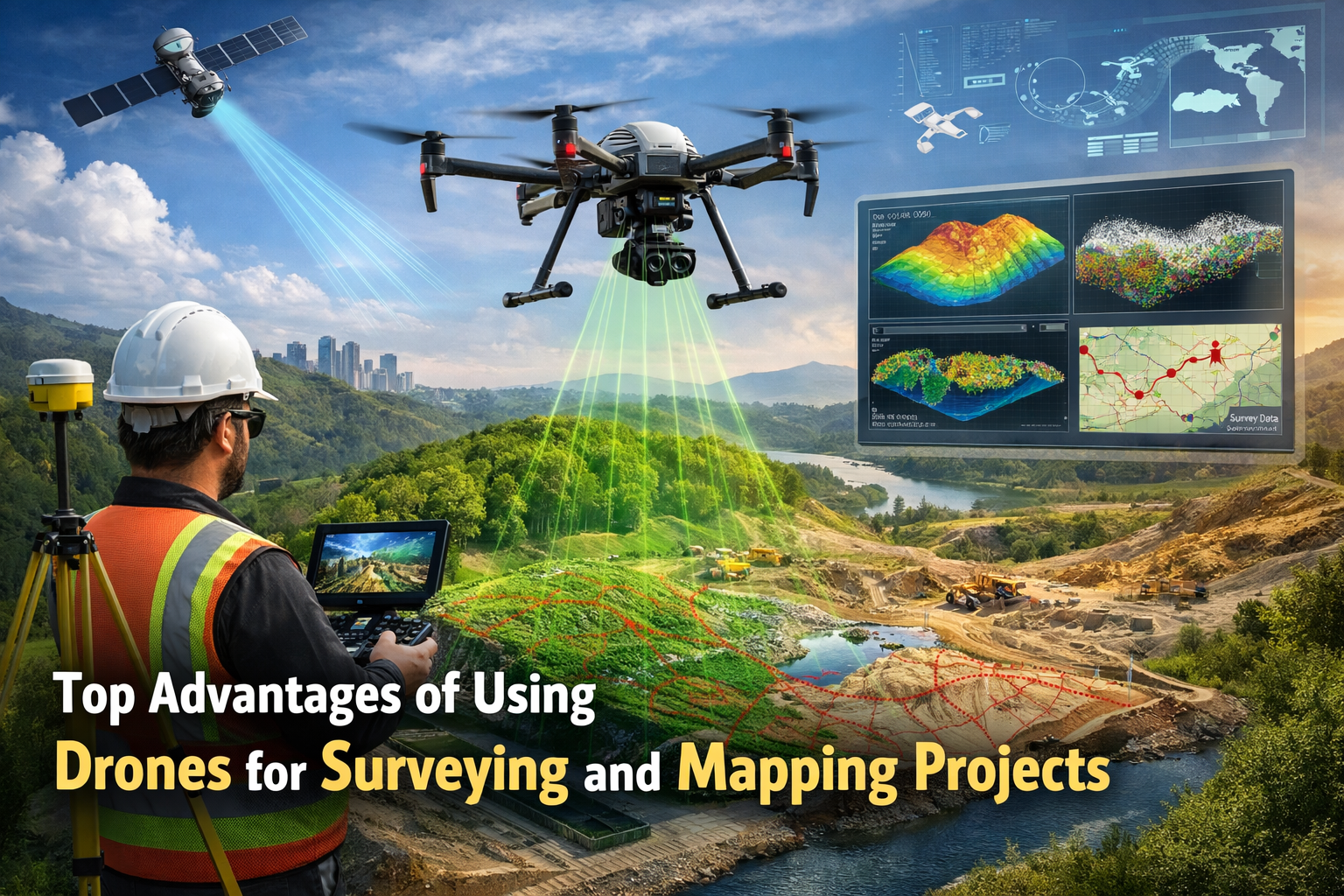
This blog explains how current drone technology is revolutionizing the workflows of professional surveying and mapping. We focus on accuracy, speed, safety, and regulatory alignment, and why drone-based solutions are now the practical choice for large-scale and regulated land projects.
Key Takeaways
- Drone-based surveys deliver higher accuracy with less on-site risk
- LiDAR and aerial data improve planning and regulatory outcomes
- Drone surveys outperform traditional field methods on large or complex sites
- Choosing the right survey partner matters as much as the technology
Introduction
One missed elevation point can delay an entire project, and drones are changing that reality.
Surveying has always been about accuracy, but today it also demands speed, safety, and compliance. Projects move faster. Deadlines are tighter. Sites are larger, more complex, and often harder to access. In this environment, relying only on traditional ground methods can slow teams down and increase risk.
Did you know? According to transportation and infrastructure studies published by U.S. public agencies, aerial survey methods can reduce field data collection time by nearly 60–70% while delivering consistent elevation results across complex terrain. Engineering firms and public agencies now rely on aerial data to meet regulatory timelines and reduce rework.
This shift is the reason why drones used for surveying have become a preferred solution for engineering firms, construction companies, as well as land developers and professionals responsible for regulating land documentation.
Drone-based surveying utilizes aerial platforms that are equipped with LiDAR sensors and imaging to collect precise terrain information more quickly and with less on-site danger.
Table of Contents
- Why Surveying and Mapping Are Under Pressure Today
- How Drone Technology Solves Traditional Surveying Challenges
- Accuracy Benefits of Drone-Based Mapping
- Speed and Efficiency Gains Across Projects
- Cost Control and Risk Reduction Advantages
- Drone Mapping for Compliance and ALTA Standards
- Drone Surveys vs Traditional Methods
- Real-World Use Cases and Industry Examples
- Choosing the Right Drone LiDAR Partner
- Frequently Asked Questions

Why Modern Surveying and Mapping Projects Face New Challenges
Surveyors and project managers operate under more pressure than ever. Projects involve larger sites, tighter schedules, and stricter review standards. Traditional methods alone struggle to keep pace.
Challenges in Conventional Land Surveys
Land surveys using only ground crews face limits that affect time, safety, and accuracy.
- Limited access to uneven or hazardous terrain
- Longer field time and heavy labor needs
- Higher safety exposure for survey crews
- Delays caused by repeat visits and data gaps
These challenges push firms to look for better tools, especially for drones for surveying and mapping tasks across wide or complex areas.
How Drone Technology Is Changing the Surveying Landscape
Drone platforms combine aerial imaging, positioning systems, and advanced sensors to collect consistent data from above. This approach reduces manual errors and expands coverage.
High-Accuracy Data Capture Using Aerial Systems
With high-accuracy drone mapping, survey teams collect elevation and surface data evenly across an entire site.
- Consistent elevation and contour measurements
- Precise digital surface and terrain models
- Better alignment with engineering and design software
This level of consistency is difficult to achieve with manual-only fieldwork.
Precision and Data Quality Advantages of Drone Surveys
Accuracy is the backbone of every successful survey. Drone systems capture dense datasets during a single flight.
LiDAR and Photogrammetry Working Together
Using drone photogrammetry alongside LiDAR improves clarity and reliability.
- Dense point cloud outputs
- Visibility of clear terrain even in areas of vegetation
- A reliable source of information to plan, grade, and design reviews
This combo reduces uncertainty in the early stages of planning.
Speed and Operational Efficiency Benefits
Time lost during data collection often delays design and approval phases. Drone systems shorten that cycle.
Faster Data Collection Without Compromising Quality
With faster surveying with drones, teams map large sites in hours rather than days.
- Wide-area coverage in a single flight
- Fewer return visits to the site
- Faster processing and delivery schedules
This speed helps decision-makers act sooner with confidence.
Cost Control and Safety Improvements
Cost overruns often come from labor hours, equipment transport, and safety risks. Drone surveys reduce all three.
Lower Field Risk Through Remote Data Capture
Thanks to real-time aerial data collection, fewer personnel are needed on-site.
Operational benefits include:
- Reduced exposure to hazardous ground conditions
- Lower equipment and vehicle use
- Fewer safety and liability concerns
For large sites, these savings add up quickly.
Meeting Compliance and ALTA Documentation Needs
Accuracy is non-negotiable for legal and transactional surveys.
Supporting ALTA Survey Documentation Standards
Drone-based workflows support Alta survey requirements by improving data clarity and consistency.
- Clear boundary visualization
- Reliable surface models for review
- Deliverables suitable for title and legal evaluation
This is where ALTA survey drone LiDAR mapping plays a vital role, especially for commercial and infrastructure projects that require precise documentation.
Drone Surveys vs Traditional Survey Methods
Choosing between drone-based and ground-only surveys depends on site size, terrain, and review needs.
Practical Comparison for Decision-Makers
- Coverage area: Drones capture large sites faster
- Concurrency: Aerial data is consistent across the entire terrain
- Timeline impact: Drone surveys shorten field schedules
- Workforce requirements: Fewer employees needed on-site
Many companies are now combining methods, and aerial data is the main driver.
Real-World Applications Across Industries
Drone surveying is already shaping real projects.
Construction, Engineering, and Land Development Use Cases
- Large-scale site for planning and grading
- Infrastructure corridor mapping
- Land expansion and feasibility studies
For instance, engineers often make use of drone data to confirm model grading before heavy equipment is delivered, thus reducing the need to make changes later.
Understanding Cost Factors in Drone LiDAR Surveys
Pricing varies based on project scope and deliverables.
What Influences LiDAR Survey Pricing
Several factors affect the lidar drone survey cost:
- Project size and terrain complexity
- Required accuracy thresholds
- Final deliverable formats
For regulated projects, ALTA survey drone LiDAR mapping may involve additional validation steps, which influence pricing but improve reliability.
How to Choose the Right Drone Mapping Partner
Technology alone doesn’t guarantee results; experience does.
What to Look for in Land Mapping and LiDAR Services
When reviewing Land Mapping and LiDAR Services, focus on:
- Strong regulatory knowledge
- Proven workflows and data checks
- Clear communication and delivery standards
This is why Drone Lidar Mapping stands out because they align technologies with the needs of survey professionals. A lot of clients opt for Drone Lidar Mapping because accuracy and compliance are more important than shortcuts.
Why the Future of Surveying Is Already in the Air
Drone technology has moved from optional to essential. For teams that value accuracy, speed, safety, and compliance, aerial surveying offers clear, measurable benefits across every project stage. Providers like Drone Lidar Mapping continue to support professionals who need dependable data, not guesswork.
Find professional drone surveillance services designed to ensure speed, precision, and the highest level of compliance.
Frequently Asked Questions
What types of projects benefit most from drone surveying?
Large, complex, or hard-to-access sites benefit most from drone surveys.
Are drone surveys accurate enough for professional use?
Yes. Properly executed LiDAR surveys meet engineering and planning standards.
How long does a drone survey take compared to traditional methods?
Most drone surveys cut field time by more than half.
Can drone surveys support legal and title documentation?
Yes, when aligned with professional workflows and Alta survey requirements.
Is drone surveying more cost-effective?
Reduced labor, faster delivery, and fewer re-visits often balance costs.