Objective
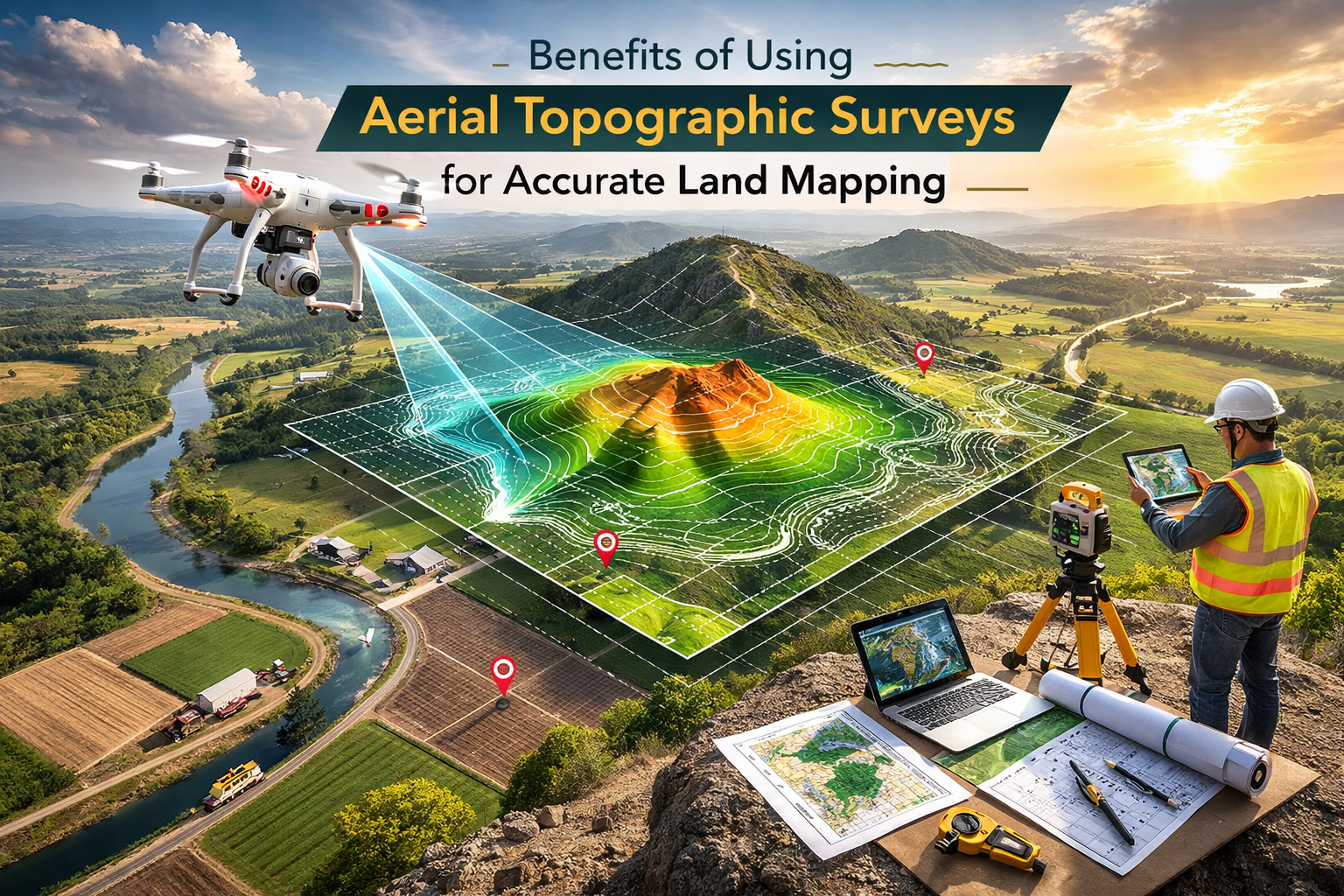
This blog educates land developers, engineers, construction managers, and real estate professionals about how aerial topographic surveys powered by drone LiDAR technology deliver unmatched accuracy, speed, and cost efficiency for land mapping projects, establishing Drone LiDAR Mapping Co. as the nation’s leading surveying firm.
Key Takeaways
- Aerial topographic surveys cut survey time by up to 70% vs. traditional ground methods
- Drone LiDAR captures millimetre-level accuracy, even through dense vegetation.
- This data is used by a wide range of industries, from construction to real estate.
- DTMs, contour maps, 3D point clouds, orthophotos, and CAD files are delivered.
- Certified providers like Skyelink ensure FAA compliance, safety, and survey-grade results.
- Drone topographic survey methods significantly reduce human error and project costs.
Introduction
What if you could map hundreds of acres of land in a single day, with pinpoint accuracy, without ever setting foot on the ground?
If you’re in land development, civil engineering, construction, or real estate, you already know how much rides on good survey data. One bad measurement and your entire project timeline can fall apart. Here’s the thing: the way we collect land data has completely changed. An aerial topographic survey is now the industry standard for reliable elevation and terrain data at scale. According to ASPRS, drone-based LiDAR surveys reduce fieldwork time by up to 70% while delivering sub-centimetre accuracy.
In this blog, we’re breaking down exactly why aerial surveys are changing the game, who benefits most, and how you can use this technology to make smarter, faster, and more cost-effective decisions on your next project.
Table of Contents
- What Is an Aerial Topographic Survey?
- Why Accuracy in Land Mapping Actually Matters
- Key Benefits of Aerial Topographic Surveys
- Industries That Count on Drone Survey Data
- Aerial vs. Traditional Surveys: The Real Difference
- How Skyelink Gets It Done Right
- The Future of Land Mapping Is Already Here
- FAQs
What Is an Aerial Topographic Survey?
Let’s break it down simply. A topographic survey captures the shape of the land, its elevations, slopes, contours, and surface features. An aerial version of that does the same thing, but from above, using drones equipped with LiDAR sensors or high-resolution cameras.
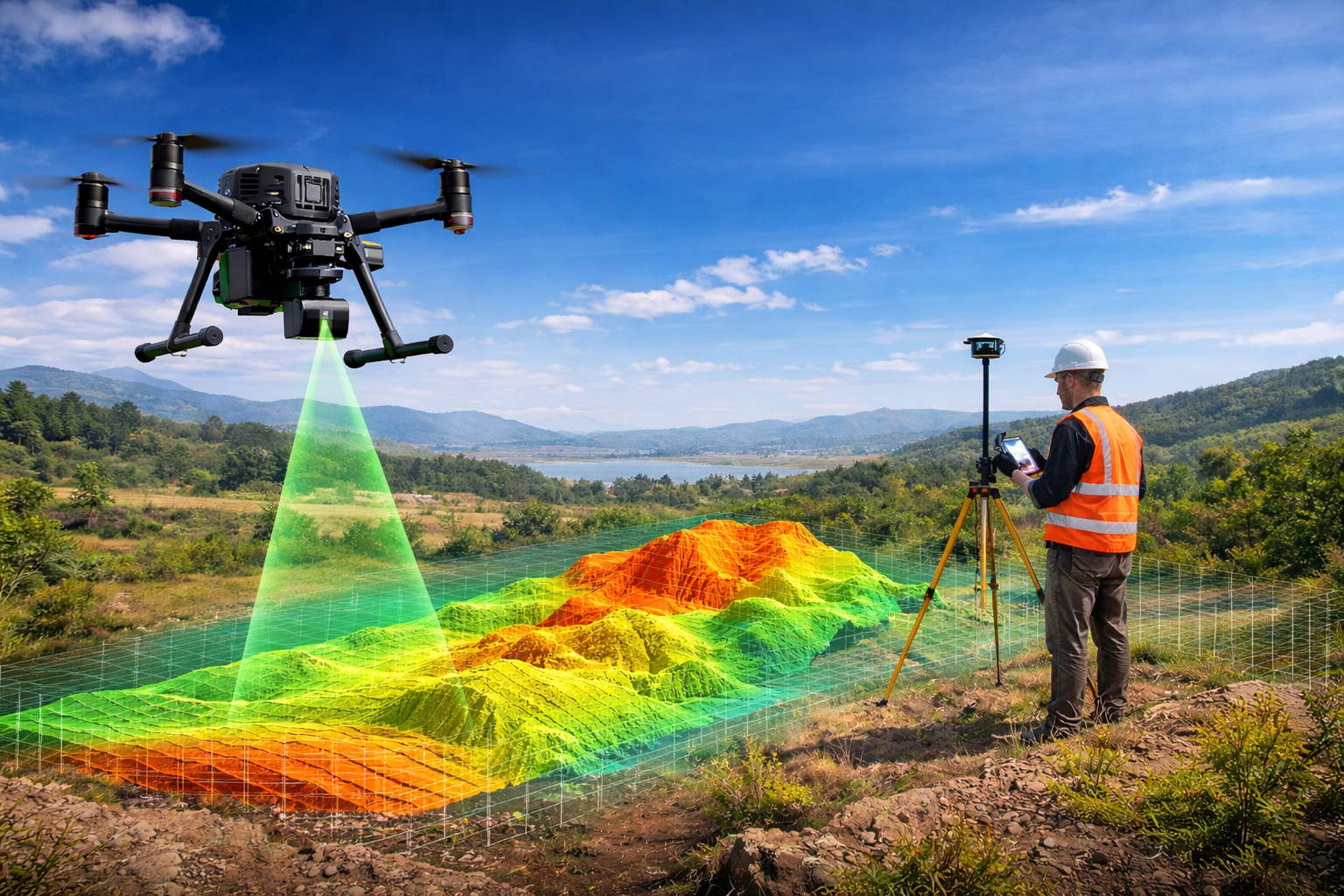
LiDAR stands for Light Detection and Ranging. It works by firing thousands of laser pulses per second toward the ground and measuring how long each pulse takes to bounce back. The result? A highly detailed, three-dimensional picture of the terrain, accurate to the millimetre.
How Does Topographic Survey Drone Mapping Actually Work?
The process consists of three steps:
- Plan of flight: The drone’s flight path is laid out to provide full coverage of the area
- Capture of data: LiDAR or photogrammetry sensors record images and elevation data during flight.
- Post-processing: The raw data gets converted into usable deliverables, such as Digital Terrain Models (DTMs), contour maps, 3D point clouds, and orthophotos.
One of the most amazing features of this new technology? LiDAR pulses penetrate the canopy of trees and thick vegetation to reveal the plain-earth below what traditional surveys cannot do effectively.
What Equipment Do Professionals Use?
The best drone for topographic survey US operations typically combines a high-grade LiDAR sensor with a stabilized camera payload, GPS/IMU systems for positioning, and real-time data transmission. These systems are flown by FAA-certified pilots who understand both airspace regulations and survey-grade data requirements.
Why Accuracy in Land Mapping Actually Matters
Here’s something people underestimate: inaccurate survey data doesn’t just cause minor inconveniences. It causes major, expensive problems.
The Hidden Cost of Getting It Wrong
Land data that is inaccurate can lead to real-world negative consequences:
- Conflicts over boundary lines that can delay or even stop property transactions
- Uncalculated volumes of earthwork that squander budgets for construction
- Design failures in drainage, which cause structural or flooding damage following an installation
- Legal responsibility in the event that survey mistakes affect adjoining properties
A single survey error in an extensive development can result in thousands of dollars or ruin the project completely.
How Drone Data Fixes This
A drone topographic survey removes most of the human error from the equation. Ground control points (GCPs) are used to georeferenced the data, meaning every elevation reading is tied to a precise real-world coordinate. The result is a dataset your engineers, architects, and planners can actually trust.
Key Benefits of Using Aerial Topographic Surveys
This is really the heart of it. Here’s what you actually gain when you go aerial.
1. You Save a Lot of Time
Traditional ground surveys of large sites can take days or even weeks. A drone can cover hundreds of acres in a single day. For contractors and developers who are working under tight deadlines, this is an enormous deal.
2. It’s More Cost-Effective Than You Think
Less labor-intensive and fewer visits to the site and faster data turnaround make for a better experience. Drone surveys can reduce the overall cost of a survey by 30 to 50% compared to conventional methods. That’s real money back in your project budget.
3. You Can Survey Places That Were Difficult Before
Steep slopes, flood zones, dense forests, contaminated sites, and drones reach all of it safely. No surveyor has to put themselves at physical risk to get the data you need. This is especially valuable for topographic mapping drones in Colorado, where mountain terrain and elevation changes make traditional ground surveys genuinely dangerous and slow.
4. The Data Is Incredibly Rich
An aerial topographic survey doesn’t just give you one output. You get:
- DeliverableFormatPrimary Use
- Digital Terrain Model (DTM) GeoTIFF / ASCII Grading, drainage design
- 3D Point Cloud LAS / LAZ Engineering, volumetrics
- Orthophoto Mosaic TIFF / PNG / JPG Visual site planning
- Contour Map DWG / DXF / PDF Construction layout
- CAD File DWG / DXF Civil engineering design
All of this data integrates directly with GIS platforms and CAD software, meaning your design team can start working with it immediately.
5. It’s Better for the Environment
Drones operate with minimal site disturbance. No heavy equipment, no clearing of vegetation for survey lines, no repeated site visits. It’s a cleaner, greener way to collect land data.
Industries That Count on Drone Survey Data
Land Development and Real Estate
Developers should thoroughly understand what they’re working on before investing in or developing land. Prior to putting a shovel in the ground, a topographic survey can provide site feasibility profiles, data on site feasibility, and boundary verification.
Civil Engineering and Infrastructure
Designing roads, bridges, drainage systems, and bridge design all depend on precise elevation information. Engineers make use of contour maps as well as DTMs taken from aerial survey data to create infrastructure that is functional on the ground.
In states that have complex ground conditions, topographic mapping drones in Colorado have been a popular resource for firms in the field of infrastructure that have to deal with elevation changes or rocky terrains, as well as different ground conditions.
Environmental Consulting
Environmental consultants need terrain data for floodplain analysis, erosion monitoring, and ecological impact assessments. Drone LiDAR is especially useful here because it captures accurate data in areas where ground access is restricted or harmful to sensitive ecosystems.
Aerial vs. Traditional Surveys: The Real Difference
This question comes up a lot. Here’s an honest side-by-side:
Aerial Topographic Survey:
- Covers hundreds of acres per day
- Millimetre-level LiDAR precision
- Safe in hazardous or remote terrain
- Multiple rich deliverable formats
- 30–50% lower overall project cost
- Vegetation-penetrating data capture
Traditional Ground Survey:
- Days to weeks for large sites
- Subject to human measurement error
- Physical risk to field crews
- Limited data richness
- Higher labor and mobilization costs
- Struggles in heavily vegetated terrain
As one industry professional put it: “The shift to drone-based LiDAR isn’t just a technology upgrade, it’s a fundamental change in how we think about site data quality and project timelines.”
That said, it’s worth noting that on very complex urban sites or heavily developed areas, combining drone LiDAR with traditional survey methods still makes sense. The best providers know when to blend both approaches.
How Skyelink Gets It Done Right
Choosing the right provider matters just as much as choosing the right technology. Skyelink operates with a national network of FAA-certified pilots and licensed surveyors; every project is insured, FAA-compliant, and handled by professionals who understand both the technology and the legal requirements around aerial surveying.
The Future of Land Mapping Is Already Here - Are You Using It?
The aerial topographic survey is no longer an emerging technology. It’s the standard that serious land development, engineering, and construction professionals are moving toward, because the results speak for themselves.
Faster timelines. Lower costs. Safer operations. Richer data. These aren’t small gains; they’re project-changing advantages that give you a real edge from the very start.
If you’re still relying on traditional ground surveys for large or complex sites, now is the time to take a serious look at what drone LiDAR can do for your next project.
Ready to Map Smarter?
Stop leaving your land mapping to chance. Whether you’re digging for the construction of a new building, making plans for infrastructure, or looking to evaluate the potential of a site You deserve data from surveys that you can rely on.
Drone LiDAR Mapping Co. offers free quotes to land developers, engineers, and construction professionals across the country.
Contact us now, and let’s get your project started with the precision it deserves.
Frequently Asked Questions (FAQs)
Q1: What is the purpose of a topographic survey?
A topographic survey records an elevation profile, the shape and surface characteristics of an area, which is utilized for planning construction, as well as drainage design and infrastructure projects. It provides professionals with an accurate, complete picture of the terrain prior to any work beginning.
Q2: How accurate is drone topographic mapping?
LiDAR-equipped drones capture data to millimetre-level precision, reinforced by ground control points (GCPs) tied to real-world coordinates. When pilots are FAA-certified and equipped with calibrated equipment, drone surveys are in line with or surpass conventional standards for accuracy in surveying.
Q3: What is the difference between a topographic survey and a boundary survey?
A topographic survey maps the physical shape and elevation of land, slopes, contours, and surface features. A boundary survey defines the legal property lines of a parcel, and Drone LiDAR Mapping Co. offers both as part of a complete surveying solution.
Q4: How much does an aerial topographic survey cost?
Costs vary by acreage, terrain complexity, and deliverable formats, but drone surveys are typically 30–50% more cost-effective than traditional ground methods. Requesting a project-specific quote is the best way to get an accurate number.
Q5: Can drones survey land covered in heavy vegetation?
Yes, LiDAR pulses penetrate tree canopies and dense vegetation in order to capture the terrain information below. The result is that drones are extremely efficient on overgrown or forested parcels where traditional surveys would be difficult or inefficient.