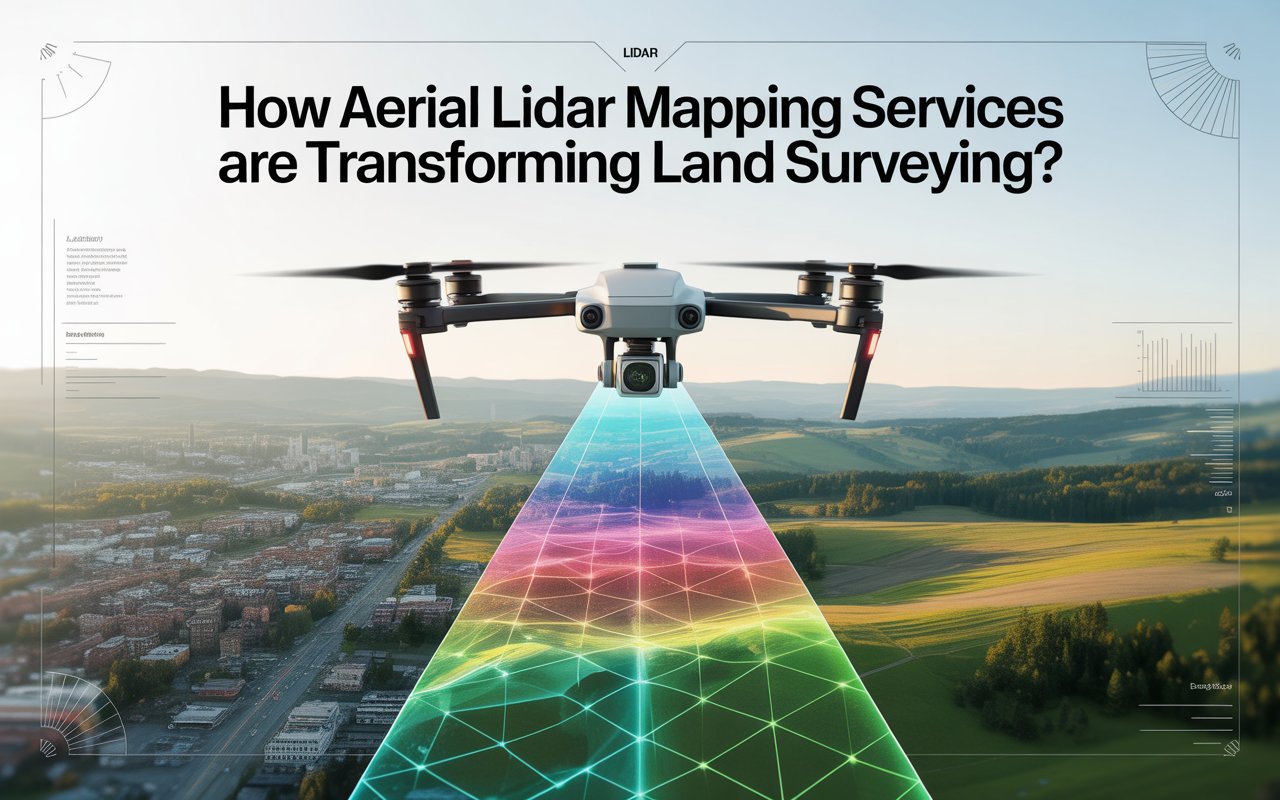
Imagine surveying a dense forest, a sprawling construction site, or a complex urban terrain, and getting centimetre-level accuracy in hours instead of days.
Did you know that aerial mapping and surveying roles are changing so fast that the global LiDAR services market was valued at USD 2.56 billion in 2023 and is projected to hit over USD 10.5 billion by 2030?
In this blog, you’ll have an overview of the drone mapping, aerial surveying and other technologies are and why they are so effective and the ways LiDAR maps, along with skilled drone surveys from a company or drone surveying company near me, can provide significant benefits for the next survey of your land especially for complicated work such as ALTA/NSPS land titles survey projects.
Here’s what we’ll cover so you know exactly what to expect:
Key takeaways
- How aerial mapping and surveying work with LiDAR and drones, and why it matters
- The main features and advantages of LiDAR-based aerial surveys
- Practical advice for selecting a provider (for example, a drone survey company or drone surveying company near me)
- Trends and what’s coming next in the land surveying sector
What does aerial mapping and surveying mean now?
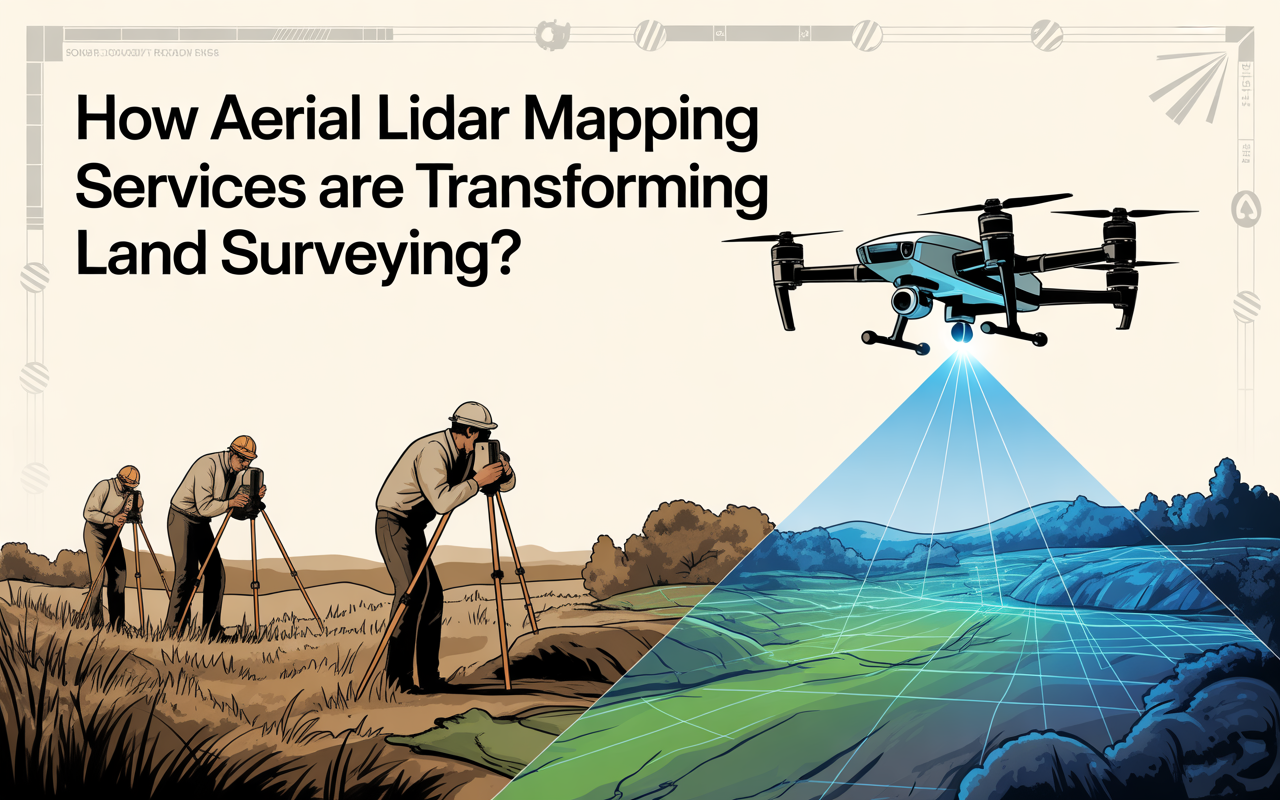
Here’s the thing: land surveying isn’t just walking with a theodolite anymore. With a shift towards digital, remote sensing, and data-rich workflows, aerial mapping and surveying open up capabilities that were unthinkable a decade ago.
Using drones equipped with sensors (especially LiDAR), we capture vast areas in high resolution, often generating point clouds, digital elevation models (DEMs), orthophotos, and 3D terrain meshes.
What this really means is that terrain, vegetation, man-made structures, clear ground, everything, can be visualised with high precision, giving surveyors and engineers powerful input data.
And to mention it once as requested: for projects like an ALTA/NSPS land title survey, this kind of data‐rich workflow is increasingly relevant, because the efficiency and accuracy gains compound when you’re dealing with title risk, boundary precision, and large site development.
Core features of LiDAR mapping services in land surveying
When you engage LiDAR mapping services, here are some of the practical features you’ll see and why they matter.
2.1 High-density point clouds through vegetation
One huge advantage: unlike traditional photogrammetry, LiDAR pulses can penetrate dense vegetation (to an extent) and return ground-surface data beneath tree canopy.
That means if your site has thick trees, brush, or complex ground cover, you still get reliable elevation data.
2.2 Survey-grade accuracy and speed
LiDAR surveys from aerial platforms are delivering vertical accuracies down to ~0.1–0.2 ft (3–6 cm) in many workflows. The processing time is getting shorter: what might have taken weeks now may be done in days.
2.3 Scalable coverage
Large tracts of land, multi-hectare sites, and infrastructure corridors all become tractable for aerial survey teams. A drone or UAV system with LiDAR can cover areas faster than manual ground crews.
2.4 Integration with mapping/GIS work
The output (point cloud, DEM, orthophoto) plugs into GIS, BIM, or CAD systems, enabling surveyors, planners, and engineers to work more effectively.
2.5 Practical table of comparative features
| Feature | Traditional Ground Survey | Aerial LiDAR Mapping Services |
| Terrain coverage | Slower, manual control | Rapid large-area coverage |
| Vegetation impact | Obstacles and limitations | Can capture beneath vegetation |
| Accuracy | High, but labour-intensive | Comparable accuracy, faster delivery |
| Data format | Survey points, contours | Point clouds, DEMs, orthophotos |
| Cost/time for large sites | High cost, long schedule | Reduced cost/time for large areas |
What this means is you’re able to take on more complex jobs with confidence and forward the value to your clients.
Why the shift is happening in land surveying
Let’s break down why clients are making the switch to working with a drone survey company or looking up “drone surveying company near me”.
- Cost-efficiency: Fewer ground crews, less time in the field, less risk of missing data.
- Accuracy & completeness: The ability to capture detailed data across the full site gives you strong coverage, fewer surprises.
- Safety: Sites that are hazardous (steep slopes, mines, dense vegetation) become safer to survey via aerial methods.
- Data richness: The deliverables are more than points; they include 3D models, visualisations, and analytics support.
- Competitive differentiation: Survey firms using advanced tech win more work.
Market data backs this up. The aerial surveying & mapping services market was valued at around USD 1.96 billion in 2024 and projected to reach USD 2.78 billion by 2032. LiDAR services market: growth at 22.4% CAGR from 2024-2030.
What this really means is that demand is strong, technologies are mature, and clients expect more from their survey partner.
What to look for when hiring a drone surveying company near you
When you’re evaluating a provider, here’s a checklist of practical questions and criteria:
- Do they offer certified survey-grade deliverables (DEM, orthophoto, point cloud) with documented accuracy?
- Can they handle dense vegetation, complex terrain, or hard-to-access areas?
- What type of drone platform and LiDAR sensor are they using? Do they capture high points-per-second (PPS) data?
- What is their data processing workflow? How quickly will you receive results?
- How do they integrate with your systems (GIS / CAD / BIM)?
- Do they have appropriate liability, professional indemnity, and site/air-space permissions?
- Will they support an ALTA/NSPS land title survey if needed (for example, boundary details, encroachments, recorded easements)?
- Can you view a sample of their work or a client testimonial?
If you tick all those boxes, you’re well-positioned to get value from a survey project that uses aerial mapping and surveying with LiDAR.
Future trends and what’s next
Here’s what to keep an eye on:
- Increased adoption of autonomous aerial mapping systems, where drones fly multi-session missions with minimal human control.
- Better data fusion: LiDAR plus optical imagery plus AI to generate rich 3D city models or infrastructure twin-models.
- Lower-cost hardware and improved sensors enable smaller sites to benefit from the tech.
- Regulations are catching up (air-space, BVLOS flights), so more flexibility for survey firms and clients.
- Enhanced analytics layer: point-cloud classification, vegetation removal, volume calculations, and change detection over time.
In short, working with a forward-looking drone survey company today means you’re not just getting a survey, you’re securing a platform for future-ready insights.
Choose precision, speed, and clarity.
You’ve seen how aerial mapping and surveying with LiDAR is reshaping the way land survey work gets done. From huge cost and time savings, to richer data, to better integration with planning and engineering workflows, this isn’t incremental change; it’s fundamental.
If you’re embarking on a major survey, development, or infrastructure project (including ones requiring ALTA/NSPS land title survey compliance), aligning with a capable partner offering LiDAR mapping services and operating like a drone surveying company near me makes sense. Choose clarity. Choose speed. Choose precision.
Ready to get started? Contact the team at dronelidarmapping.com to explore how their aerial LiDAR solutions can support your next land survey.
Faq’s
What is the difference between aerial LiDAR mapping and traditional land surveying?
The mapping of aerial LiDAR employs drones or aircraft to quickly capture massive 3D clouds across vast areas. Traditional surveying on land is based on ground workers and manual instruments that are more time-consuming and cover a smaller area.
How accurate are LiDAR-based aerial surveys for land-surveying work?
They can deliver vertical accuracies of only a few centimeters under the right conditions, making them comparable with survey-grade measurements.
Can a drone surveying company near me handle sites with dense vegetation?
Yes, LiDAR pulses are able to traverse gaps in foliage to collect ground surface information underneath the vegetation and trees that traditional methods cannot.
Is engaging a drone survey company more cost-effective than conventional survey methods?
Most of the time, yes, since the aerial surveying and mapping cut down on field time, cover greater areas faster, and offer higher quality data. They often reduce the total cost of a project.
What should I check when hiring a drone survey company for an ALTA/NSPS land title survey?
Make sure they have high-quality deliverables for surveying, clear boundaries, compatible data formats that work with GIS/CAD systems, and manage ALTA/NSPS requirements as well as complex site requirements.